Monday, February 13, 2017

Fishing with Curt Whiticar by Ernest Lyons


Early Labor Day morning I went out commercial fishing with Curtis Whiticar on the “Howdee”, a small charter craft which used to belong to DeWitt Upthegrove in West Palm Beach.

The “Howdee”  has caught her share of sailfish, but when sport fishing went the way of many other non-war essentials a couple of years ago, Capt. A. A. Whiticar, Curtis father, bought her and refitted the craft for the more serious business of hauling in mackerel and bluefish. She furnished a great many thousand pounds of seafood by the hook and line method during the emergency-and is still doing it.

The trip started out right with a rare human   element-consideration   for   the other fellow. As we eased down a narrow channel past a moored houseboat, Capt. Curtis slowed her down to a crawl. “Has it   shoale here?”   I   asked “No,”   he replied. Im just keeping our wake from rocking  that  houseboat. You  can  put that down in my book as one of the top reasons why Curtis Whiticar is one of the ace charter captains of the Martin County fleet

Easing out the inlet in a grey dawn, we saw ugly rain squalls north and south, but edged between them to the northeast-and soon  had  four stout  hanlines trailing, with two 3 ½ Drones on outriggers and a couple of feathers astern

Before  had  time  to  get  my  gloves  on those  hand  lines  went  into  action,  and soon there were three big king mackerel, four blue runners, a jack, a small Spanish mackerel and about a 15 pound barracudthreshing  and  flailing  in  the fish box. Although the clouds grew more menacing,  we  continued  on  oucourse, and about six miles offshore Curtis unerringly   located   a   small   red   buoy which he had placetmark hidden reef

“Here it is, he said. Ill get the grouper lines ready while you stow the trolling gear.” 

He idled the “Howdee down and a small dolphin  struck  as  I  brought  in  a  stern line. While it was still threshing in the box one of the outriggers bowed-and  Curtis said “Get your gloves on for this fellow.” 

I really needed him them. What a fish! If you don’t believe it, try hauling in a 30- pound amberjack man to man. While I was still breathing harfrom this exertion; he said-“and heres another. I am now thoroughly convinced that the only thing harder to haul in than a 30- pound amberjack is a 35-pounder which was next on the bill of fare

Meanwhile it was getting rougher. The squall hit and we  were  enveloped  in cloudof rain.  That is-we thought we were. Before we came in we were to know what real rain could look like

Finally the sea flattened, and over went the grouper lines, baited with chunks of blue runner. “I find, said Capt. Curtis delicately, that the novice sometimes has difficulty in this deep water reef fishing. He fails to pull fast and hard enough to take the belly out of the line and set the hook.” 

“Yeah, thats so, I agreed, feeling sorrfor the poor novices

There must be some other reason. Curtis haule in   fou big   grouper   an a beautiful 13-pound red snapper while all I did was feed em bait with my feeble jerks  at  thhand  line.  What  a  fellow needs in that sort of fishing is six-foot arms

All this time it had been raining intermittently, and the sea got to kicking up more and more, so we called it a day and  started  in.  Myself,  Ill  bhonest about it, if Id been at the helm I wouldn’t have known which way to go. Six miles offshor in    rain   squall I   would probably have headed for the Bahamas

We  saw  some  beautiful sights  going  in. Veering winds created a hillocky cross- chop with considerable ground swell-and the flying fishes showered like little silver birds ahead of us. Once we saw a great hammerhead shark lolling on his side just ahead of our bow and it rained. A 10- pound king mackerel whanged onto an outrigger-and I insisted on dangling him overside two or three times   until Capt. Curtis kindly took him away from me

And  it  rained.  It  rained  like  it  used  to rain.  It  rained  in  solid  wall,  anthe little “Howdee rode through the squalls without a sight of land unerringly to the inlet mouth. Going in over the bar an 8- pound cobia latched on a Drone, and he was still kicking when we got inside the river

I had a wonderful time. Just the memory of  hauling  in  that  last  35-pound amberjack was something. Of course, Capt. Whiticar, all alone one time, using an   ordinary   han linebrough to boatside from the reef bottom and landed a jew fish which weighed 265 pounds, dressed with head and tail cut off. Hes modest about it, not with a rope or shark hook-but with an ordinary tarred hand line

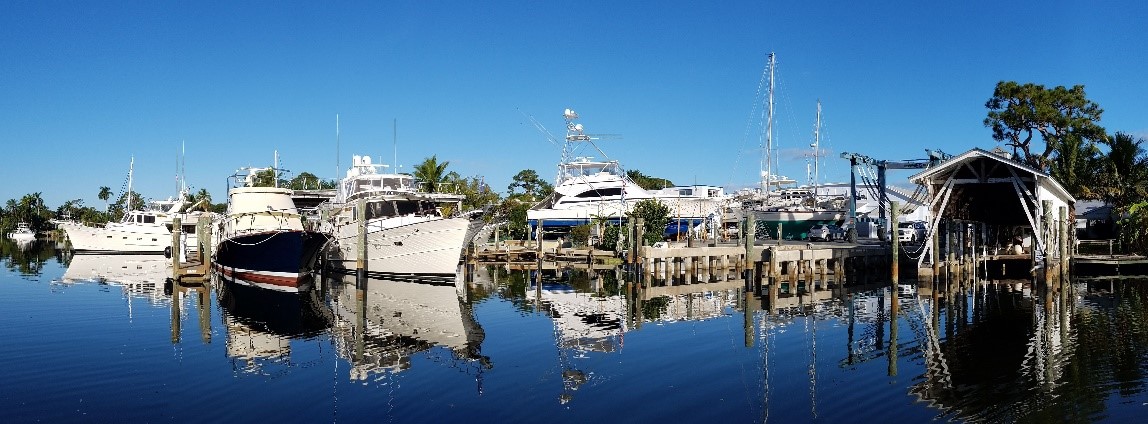
Back at Salerno, we unloaded our edible catch at Banks Shelton’s fish house, and the   barracud an amberjack  at   the shark house, and were soon under cover again in the Whiticar boathouse at Port Sewall, where Capt. Curtis showed me the initial work on a 34-footer charter craft he is building  with his own hands for use in sailfishing. I hope sometime to have the pleasure of going out in it with  him-and know that I will enjoy myself just as thoroughly as I did Monday on that trim little sea boat, the “Howdee.

Stuart News ~ 1945 - E.L.


Is Pod Propulsion the future for boats?

At the 2005 Miami Boat Show Volvo Penta introduced its Inboard Performance System (IPS) and changed forever not only the way we run our boats but the way we think about running them.
Before, guiding required planning, logic, coordination, and strategizing; after, it became simple intuition: Look where you want to go and point the direction control that way. They said it was so easy a child could do it, and sure enough, it wasn’t long before a man just out of kindergarten skillfully manipulated a 40-footer into a slip all by himself.


IPS also claimed more speed and better fuel efficiency (the precise amount of each is still up for discussion), and thanks to its behind engine placement, more interior space, and lower interior sound levels. Still, many boaters weren’t convinced. One described his skepticism stating the following: “It’s just too good to be true...!- There’s must be a hidden cost that no one has factored in.”

The Unidentified


Over the years, I’ve found online forums to be some of the most common places for first-hand accounts of engine-related problems. Certain, the stories are one-sided, but as an total source of information, can be concluded that pods are no more disposed to letdown than inboards but that when a pod breaks, the repair bill’s going to be higher.

Everyone fears the unknown, especially boaters, many of whom still consider pod drives something strange. Hang around a boatyard, and you’ll hear at least one horror story about some unfortunate soul who was stuck, because his pods failed. These are often second- or third-told tales with a questionable attribution and few verifiable facts.

Pods are comprised of some very costly components, but theoretically, their modular design should yield some countervailing savings in labor costs. 

Difficulty


Conventional wisdom seems no longer applies. Today electronics are intimately entwined with every aspect of our lives, and whether it’s commercial jet engines, cars, home appliances, or chart plotters, we expect and receive virtually bulletproof reliability.

So, the fact that pod systems are full with electronics actually makes them less likely to failure—and unfortunately a deep mystery to most mechanics. Unhappily, the fact that electronics don’t respond well to basic force may mean some service challenges, at least in the short term, which is why long-distance cruisers have, as a group, been cautious of pods.

Pods have more parts, both mechanical and electronic, and conventional wisdom says that means more problems. The inboard has simplicity and ubiquity. Pull into any port in the world, and there’s probably a guy there who can fix it. 

Upkeep


To keep Inboards, require sacrificial-anode replacement, prop adjustment, cutless bearing repair, shaft alignment, and a method of controlling marine growth. Pods require drive-oil changes every 250 hours or annually. Also, demanding periodic attention are hydraulic steering, transmission, and lower-unit oils. Everything told, figure $500 per engine annually, plus haul-out fees.

Most pods also require periodic removal and inspection of prop sets and seals, and re-greasing of the prop-shafts - figure $250 per pod.

All up, pod owners can expect to pony up something like an additional $2,500 for scheduled maintenance. That’s not mark change! and while it’s hard to nail down the amount of that fuel-efficiency edge, everyone agrees it does exist and can compensate you for at least some of the additional maintenance costs. Either if you’re a do-it-yourself, you’ll discover that a lot of pod maintenance requires specialized tools and training. 

Inertia


Like long-distance cruisers, sport fisher-men have been slow to accept pods, in this case not because of supposed deficiencies but rather an unwillingness to try anything that might reduce chances of success. Better fuel efficiency? More interior room? If they don’t increase the odds of hooking up, who cares? And maneuverability—well, any good sport-fishing captain can put his ride wherever he wants—without a control.

Initial Fee


The true of all is that Pods cost more, But how do you compare boats? Imagine a 44-footer with three cabins, two heads, and inboards priced $20,000 less than an identical 44-footer with pods that, thanks to its aft-engine placement, has one more cabin or head. Wouldn’t accommodations be the more relevant measure? And what of resale? How much of the additional initial cost will you get back at trade-in time? We’re still trying to sort through the answer to that one.

There are many reasons why everyone’s not on the pod movement. But tick them off and it’s hard not to conclude that the trend is undeniable: More boaters prefer them every year, and while they’ll never completely replace inboards, they are the future of boating. As one broker comments, “It’s like automatic transmissions. At first no one trusted them; now you can hardly sell a car without one.”

*While traditional shaft drives are oriented out Ans away from the vessel, IPS drives feature forward facing props.


If you have any questions regarding your boat or need maintenance or repairs, we recommend Whiticar Boat Works! leader and premier service provider in the marine industry. It is a well-known and reputable company located in South Florida. It was founded in 1949 by Curtis ´Curt´ Whiticar. Whiticar Boat Works is a family owned & operated company. They have multiple locations in South Florida. For more information about us check out the website  http://www.whiticar.com/wp/   or call us (772) 287-2883
References:

Thiel, R. (2016, 02 13). The Truth About Shafts and Pods. Retrieved from Power and Motor Yacht: http://www.powerandmotoryacht.com/boats/truth-about-shafts-and-pods


Tuesday, January 17, 2017

Recommendations to select the right Boat


As many prospective buyers struggle with the buying decision of a boat, and it’s a difficult decision to take, lest explore the four basic hull shapes that embody the vessels in today’s trawler community. 

HULL SHAPES

Planing Hulls are relatively new to our cruising fleet, yet they offer benefits that make them ideal choices for some people. These hulls ride on top of the water beyond hull speed, offering high speed and performance that is relatively efficient. The planing hull is a great choice for those with limited time for cruising. In fact, many dealers find new buyers are able to make extended cruises in short order, getting to the cruising grounds quickly and then slowing down to smell the roses.

The planing hull is also not very comfortable or easily handled in rough weather; the boat must be slowed down and often becomes squirrelly as a result. And the somewhat limited storage and tank capacities tend to keep things simple. 

Another hull shape to consider is the Semi–displacement Hull Form. It has a shape flat sections behind and a bow that lifts for higher speed, allowing operation over a wide range of performance. This hull is efficient at displacement speeds, yet it offers a higher speed potential if desired. The semi–displacement hull is a good compromise of hull features, offering good storage and sufficient tankage for extended cruising and a proven record as a liveaboard cruiser. The disadvantages of the semi–displacement hull is that it is not as stable in rough seas as a true displacement boat, and handling can also be difficult in following seas (the generally flat severe is a big target for waves coming from behind).

The Full displacement Hull Shape travels through the water and is by far the most traditionally seaworthy shape for a cruising powerboat. It is most comfortable at sea and at anchor, has good fuel economy, and goes the distance with long range. Its superior storage and fuel and water tankage allows for great living aboard and extended cruising, especially when there is no schedule to follow. Its disadvantages are that it is the slowest hull shape, often along the order of 7—8 knots. The seaworthy shape is disposed to rolling in a seaway, so some form of stabilization is usually fitted for crew comfort. The full displacement hull also has the deepest draft, although most builders try to keep this from being excessive to allow cruising in paradise grounds lacking deep water.  

The Power Catamaran is the latest hull shape to come into our market, and it’s unusual enough to warrant its own category. Displacement cats have a wide performance envelope, often using a small diesel engine in each hull to reach respectable cruising speed with good fuel economy. Power cats have generally shallow draft and offer form stability due to the wide footprint of widely spaced hulls. However, unlike their sailing complements, there is no sail rig to contend with and they are not as beamy, so you don’t face the dockage issues that you do with a sailing cat. The downside of a catamaran is its inability to carry much weight, as all aspects of its performance suffer when the boat is loaded too heavily. These craft work best when they are kept light, and only the larger power cats can handle the full–time live aboard accommodations and storage that many couples require.

Another key issue for many people is deciding what kind of style you embrace. Do you wait for perfect weather, or do you go no matter what? Will you anchor out most of the time or stay at a marina? Do you tend to move around or stay in one place during a cruise? Knowing your style will help refine your comfort levels and dictate what kind of boat might work best. Subtle design elements will support one style over another, so it helps to know your style before discussing a particular boat with a dealer.

Along with layout choices, another area that is almost more crucial for happy cruising than the boat itself is a careful review of the boat’s systems and their accessibility. I always recommend reviewing major systems for single points of failure—points where, if they fail, the system no longer works. A surveyor can often assist with this evaluation, but only if he or she is charged with this specific task.

But the most important thing I offer is that you can go cruising on any boat. Just think it through, find a boat that fits your needs, and go cruising. The worst thing you can do is rob yourself of the joys of cruising while dreaming of an adventure never to happen, on a boat that is out of reach. Just do it!

Whiticar Yacht Sales is the brokerage division of Whiticar Boat Works, Inc. which has an established 50 year plus reputation for pedigree custom sportfishing boats, quality boat repairs, and expert marine service. You can contact our office (772) 219-3425

Whiticar Boat Yard for all of your boat repair, maintenance and yachting needs. Stop by. See for yourself what Stuart, FL and Whiticar Boat Yard can do for you.  We are located on Willoughby Creek in Martin County, Florida, just two miles east of the St. Lucie Inlet, Or call our office (772) 287-2883. You can also visit our website http://www.whiticar.com/wp/about-our-crew/  Yacht Sales Department, we are always ready to assist you!  


Thursday, December 15, 2016

FISHING REPORT FROM THE SHORE AT THE TREASURE COAST FLORIDA


As the weather gets colder, the fishing gets hotter! Following the reviews about fishing Inshore / Nearshore on the Treasure Coast, its seems to experience a lot of changes for fishing. 

The snook have moved back up river where they stay for the winter in more salty water. They can be caught fishing bottom baits along the bridges and deep channels. Lots of big snook are caught using First Light Jigs. The technique for using these 1-to-2-ounce jigs involves casting up-current and retrieving down-current at a speed that keeps your jig very close to the bottom. These snook will sit belly-down on the bottom where the water is usually warmer during the colder months.
The snook will usually be close to the bridge supports to get out of the current. We also find snook sitting along seawalls that face the sun in the morning back in the St. Lucie River. For those snook, we use top water traps and flies to simply cast close parallel and pop down the wall.
Snook season will soon end but you still have time to catch some big ones and possibly a keeper or two. When it rains, the locks must open and this is the place to be when they are opened. You can catch over 30 snook a trip. Just being there at the right time is all the battle.
The pompano has started showing up along the beaches for surf-casting using 9-to-12-foot rods. For attraction, we use sand fleas, clam’s meat, shrimp, and flavored fish-bites artificial bait strips.
Incoming waves is much preferred with fishing from the beach for pompano. The pompano will also come inshore and school up on the flats. Inshore, we use jigs, sand fleas, and shrimp.
Pompano guys, if the wind stays strong like it has been, look to the river and bridges. Jigs will be your best bet. Jensen Beach and Little Jim bridge are hot spots. You can’t miss where it is because everyone will be lined up jigging. Look for Walton Rocks Beach to be the very best place if the wind lays down. River and wading will be hot for trout and red fish. You also can’t beat the places north of the power lines. Shrimp under a popping cork is the way to go but top water and plugs will work great.
The Spanish mackerel are also showing up along the beaches and the well-known Peck Lake Reef where hundreds of anglers and commercial fishermen can be found throwing jigs and gotcha lures. It’s a great type of fishing for family members and inexperienced anglers to easily get hooked up!

When fishing from the coast, the fish hang out there when the water is flowing to eat all the little baits that come over it. Look for pools of calm areas. I use plugs that look like mullet to get best results. Swim attractions like storms work well, but if water is running hard, it is better to use plastic to get the bite.

Bridge fishing will be good, but you must get deep to get where they are feeding. Skill Hawks will help here. Waterfronts will also hold some snook.
Bluefish have moved in and the best place to get these guys is Hobe Sound Public Beach on cut bait like mullet and spoon lures. Tie a 50-pound mono leader on and then hold on. There will be plenty of sharks in the area, so get the blues in quick.
December is here and it’s not just the holidays that we have to look forward to. With every cold front this month, a new body of fish should push down the beach in search of warmer water and a constant food source. Blackfin tuna, sailfish, dolphin and everything else will migrate south along our reef systems and current edges.

Focus around faint temperature breaks and color changes with both dead or live bait for success. That being said, this is my favorite time of year to troll.


Naked ballyhoo rigged on 6/0 mustad circle hooks are my bait of choice and I definitely like to have a squid chain out there as well. A lighter set of poles will increase your hook up ratio, which is key to a successful day of catching. Blackfin Rods makes an off the chain sailfish rod that is great for both trolling and live baiting.

When weather permits, this is also a great time of year to go swordfishing. Over the last 10 years, daytime swordfishing has become extremely popular and the Treasure Coast offers great opportunities at catching these gladiators. Fishing dead baits a quarter-mile below the surface can provide one of the most exciting days of fishing you’ve ever had when it all comes together.

These fish are sometimes more than 500 pounds and will test every aspect of your fishing game. Whatever it is you decide to do this winter, I hope your trip is off the chain. Enjoy this time for fishing and spoil yourself with stuffed salty presents in the form of the many offshore species of fish that inhabit the coastal waters of Martin County. Local anglers will be able to enjoy the seasonal excitement of being able to intersect and catch an all-star lineup of offshore game fish like sailfish, dolphin, king, spanish mackerel, grouper, and snapper. Florida`s winter weather will be in full swing this month, hosting the typical procession of cold fronts that will pass over our peninsula with fresh breezes.

These fronts and the winds associated with them, will directly determine offshore conditions and force anglers to plan their ocean fishing trips around daily weather forecasts and the sea states they encounter. While there will be many rough ocean days this month, there will also be many favorable weather windows for fishing in between the arrival of cold fronts.

Locating bottom structure to employ one’s fishing strategies upon, will be the key component to catching success during the month of December. Trolling, drifting, and anchoring strategies for deploying baits is always enhanced when doing so around and over top of some bottom (reef structures). Grouper will be at the top of the holiday fish wish list, as December will be the last month of an open catch and keep season that will close at midnight, December 31.

Lane, mangrove, and mutton snapper will also be high on the wish list and will be found in good numbers from 50 to 90 feet of water, especially around artificial reefs just east and northeast of our St. Lucie Inlet. So, in December, make your fish wishes come true by fishing around “bottom” and post up on one of the many “honey holes” that make up the reef system, offshore of Stuart.

Whether by land, air or sea, you can reach Whiticar Boat Yard for all of your boat repair, maintenance and yachting needs. Stop by. See for yourself what Stuart, FL and Whiticar Boat Yard can do for you.  

We are conveniently located from I-95, only one-half mile from Witham Field Airport, and just west of the Intercoastal Waterway at marker 13A


 Wishing you Happy holidays from all our team!


Wednesday, November 23, 2016

Top Recommended Places For Boating and Leisure Activities on The Treasure Coast - Florida

The Treasure Coast is considered a boater's paradise as the area offers fantastic opportunities to spend time with family and friends while you enjoy sailing on your yacht. If you want to dock up for drinks, dinner and a vibrant nightlife you will like to drop anchor in the great Florida Treasure Coast.


1. Peck's Lake – Stuart, Florida 


It is located right off the Intracoastal Waterway in Stuart, Florida. Part of the charm of this location is its privacy, there are no facilities, so make sure to pack everything you'll need to comfortably spend time on the virgin white sand beach, it is a passive destination for a seaside retreat where boats of all sizes can anchor up. For more fun activities, you can bring your paddle boards, kayak, and fishing rods. 

If you are making a day trip to Peck's Lake from the south, you'll have a stunning ride up. The manatee zone between Hobe Sound and Peck Lake will slow you down and it will give you more time to enjoy the beautiful scenery. 


2. Pirate's Cove Resort and Marina - Port Salerno, Florida


This energetic waterfront resort is located in the Manatee Pocket, it’s the perfect place to dock up and have a little fun in the sun. After you get off your vessel, most people  head to the waterfront Tiki Pirate Bar. There you can kick back, have some food and drinks in a casual beach setting, enjoy live music, enjoy drink specials and some others activities. Whether you are spending some time with the whole family or in a romantic date, take in the beautiful waterfront views of the Manatee Pocket.


3. Historic Downtown Stuart – Stuart, Florida


Sunset Bay Marina and Anchorage is an exceptional spot to dock your boat for the day or evening in Stuart. The large marina has 198 slips, many of which can accommodate yachts up to 150 feet in length. Once you dock, you can take advantage of the marina club house which offers customers a range of services and amenities. Docking your vessel at Sunset Bay Marina will give you an easy access to Historic Downtown Stuart, a charming portion of Stuart that exhibits a laid- back old-Florida atmosphere which it is completely pedestrian-friendly.

The Atlantic Coast city of Stuart was recently voted as the number #1 “happiest shore town” by Coastal Living Magazine. That ranking should be enough motivation for you and your family to cruise through Stuart, Fl. for a joyful visit. 


4. Manatee Pocket - Port Salerno, Florida


If you're a boater looking for the ultimate bar-hopping opportunity, you will find it at Manatee Pocket - Port Salerno, Florida. On its beautiful protected waters, you'll find a sweet set up of three enthusiastically popular, ideally located dockside restaurants. Whether you visit, during the day for lunch or at night for a little extra fun, these establishments in the Manatee Pocket area are sure to deliver a good time.


5. Fort Pierce City Marina and Main Street – Fort Pierce, Florida


The floating docks at Fort Pierce City Marina have wet slips that can accommodate vessels up to 160 feet depending on draft. In the more northern region of the Treasure Coast off, at the Indian River Lagoon is the historic seaside town of Fort Pierce, another ideal location for a yachting day trip.

Once you’ve secured your ship, the opportunities for enjoying your day here are endless. A variety of markets, restaurants, shops, boutique, live music, and beautiful colonial Spanish architecture await you as you make your way into town. Fort Pierce's Main Street was voted as one of the 50 Best Small Towns by Top Value Reviews as it has so much to offer. 


6. St. Lucie Inlet Preserve State Park – Port Salerno, Florida


On the Atlantic Intracoastal Waterway side, there is a dock with many available slips to dock boats up to 32 feet in length. A boardwalk will take you across forests of mangroves and hammocks of live oaks to a nicely preserved quite Atlantic beach. Just at 2.7 miles away you can find a white sandy beach available to you while you enjoy your day trip or weekend getaway. 

One of the few remaining undeveloped barrier islands on Florida’s east coast, the St. Lucie Bay Preserve State Park, is accessible only by boat and totally worth the ride. Visitors come here to swim, sunbathe, kayak, surf fish, or picnic at the beach tower. Snorkeling and scuba diving are also popular activities at this state park. 

Important fact: There is a lot of shallow water in this area. Be sure to head out of channel right by the big dock sign that reads "St. Lucie Inlet Preserve Park."


While you are boating through any of these beautiful places, remember the importance of having Whiticar Boat Works phone number handy, in case you need assistance or service for your boat.

Whiticar (Stuart) 772-287-2883
• Whiticar (Fort Pierce) 772-460-0660
• Shearwater Marine & Industrial 772-781-5553

Whiticar technicians have extensive knowledge and training to assist you with any of your boating needs.

Whiticar has 2 full service boat yards and they also offer the following Mobile Services:
• Main Engine and Generator Service
• Marine Electrical
• Air Conditioning and Refrigeration
• Plumbing Systems/Pumps and Strainers
• Hydraulic and Steering
• Stabilizers
• Electronics
 Carpentry Services